Your Voice || Our Voice
A participatory mixed-reality installation exploring how computational systems distort, reconstitute, and embody democratic hopes and fears.
What happens to democratic expression when computational systems do not merely transmit speech, but transform it?
Your Voice || Our Voice was created for What Does Democracy Look Like? at the Museum of Contemporary Photography. Visitors entered a gallery structured around contrasting images of American public life and were invited to speak their hopes and fears for democracy into an iPad. The installation then made computational mediation materially visible by transforming that speech and returning it to the room through estranged virtual speakers.
A curated gallery, computational pipeline, and mixed-reality public.
I curated the installation, designed its interaction model, and developed the computational and mixed-reality system. The project linked speech recognition, current news, algorithmic transformation, market-derived sentiment, database storage, and embodied AR agents into a single gallery experience.
My role
Curator · Designer · Developer. I created the installation concept, selected and arranged the gallery logic, designed the participant interaction, and built the computational pipeline and mixed-reality visualization.
A testimony moved through several systems before returning as a public utterance.
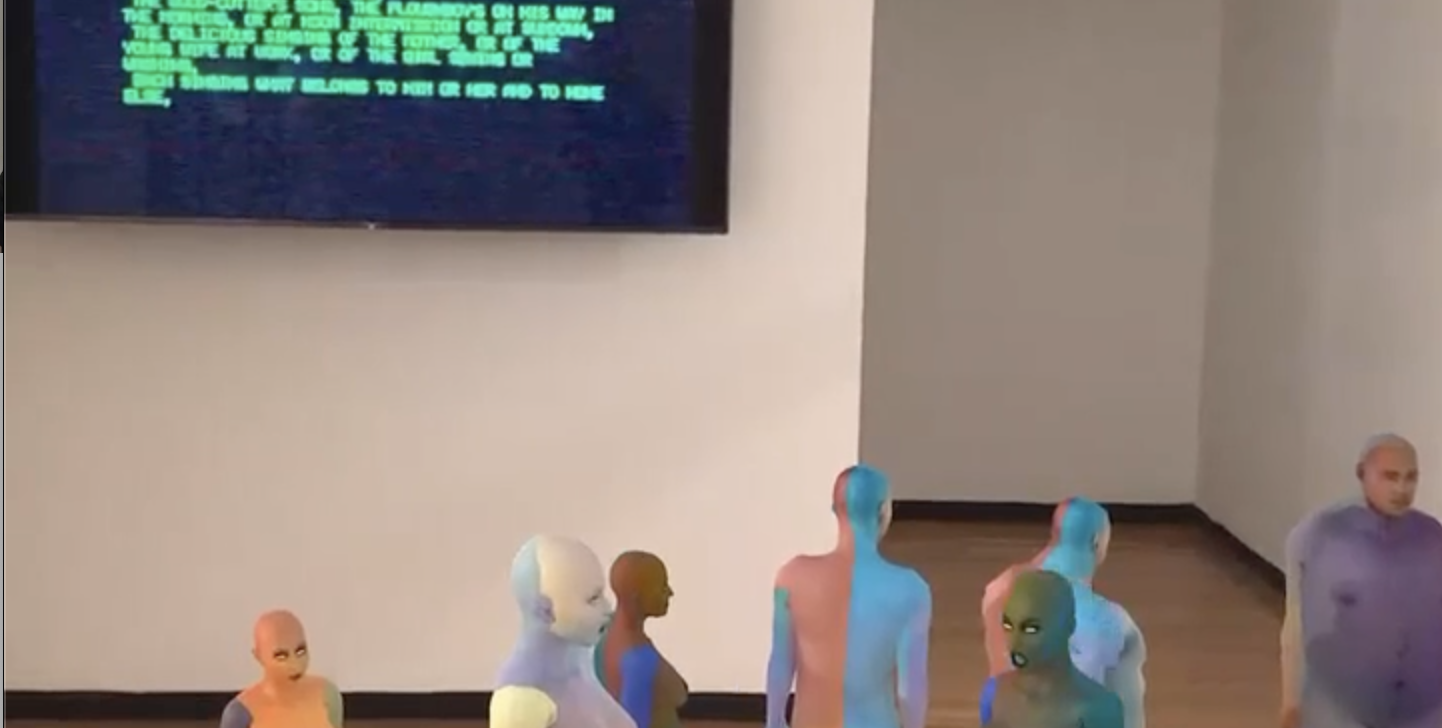
A participant’s spoken testimony was converted to text, combined with current news and information, algorithmically transformed, and assigned affect partly through the direction of the stock market. The resulting corrupted phrase was attached to a virtual avatar that walked through the gallery repeating the transformed statement.
Both the original and transformed text were retained, making the system’s intervention inspectable rather than erasing the difference between what the participant said and what the computation produced.
The gallery accumulated a computational public over time.
As more visitors contributed, the room filled with virtual figures visible through the iPad. The installation made the computational layer simultaneously invisible to the naked eye and materially consequential through the device—a deliberate metaphor for platform mediation in democratic culture.
The installation sat inside a broader argument about democracy and representation.
The physical gallery juxtaposed Greg Stimac’s images of Americans mowing lawns with photographs of struggle, violence, and social justice by artists including Darryl Cowherd, Shelby Lee Adams, and Manuel Álvarez Bravo. The mixed-reality layer inserted a third condition: public expression transformed by computational systems that participants could influence but not fully control.
Walk through the installation and its curatorial context.
The full gallery can be revisited as a 3D scan.
An early experiment in computational authority that now reads as a precursor to my AI research.
The project predates the current generative-AI boom, but its central question remains contemporary: a computational system participates in expression, introduces external data, alters affect, and returns that transformed speech to a public. The installation therefore connects my earlier mixed-reality practice to my current research on agency, interpretive authority, and AI-mediated communication.