PlayWard
A human-centered AI tool designed to help busy child life specialists rapidly create personalized play-material prompts while keeping professional judgment at the center of the workflow.
Personalized play matters, but child life specialists have almost no time to become prompt engineers.
Child life specialists use play, art, puzzles, and other activities to support pediatric patients through difficult hospital experiences. The practical problem is time: specialists need materials tailored to an individual child, yet often have limited technical literacy and little time to learn the idiosyncrasies of multiple generative-AI systems.
PlayWard was conceived as a human-centered layer between the specialist and the generative platform. Instead of asking a clinician to engineer an effective prompt from scratch, the system helps structure a child-specific activity request that can be taken into the AI tool the specialist already prefers.
A year-long client project structured around domain expertise, iteration, and student ownership.
I originated the project, established and managed the external relationship, and supervised the student team through problem definition, interaction design, prototyping, testing, and development.
My role
Faculty Lead & Project Director. I originated the project and partnership, managed the client/domain-expert relationship, and directed the student team’s design and development process. The students were responsible for the high-fidelity prototype and subsequently chose to continue the work as a business.
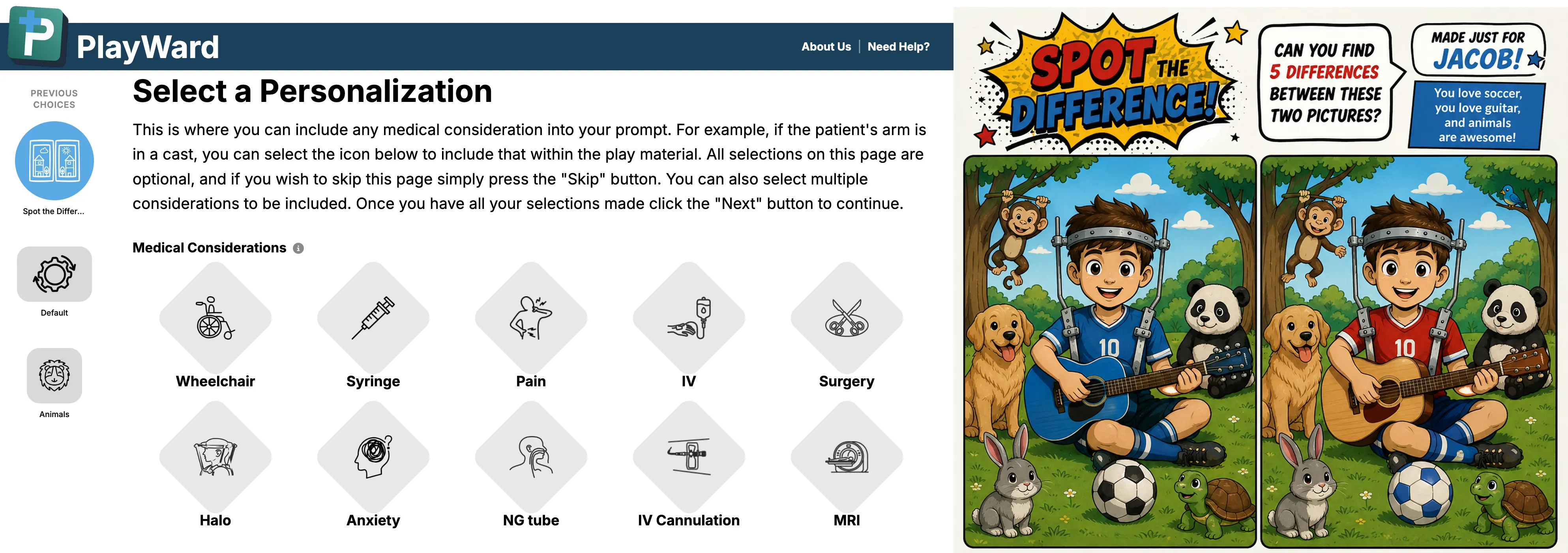
The specialist chooses an activity type; PlayWard helps produce a patient-specific prompt.
The final prototype supports five activity categories: coloring pages, spot-the-difference activities, hidden-object pages, crosswords, and word searches. The specialist supplies the child-specific context, and PlayWard structures a customized prompt that can be used to generate material tailored to that pediatric patient.
The project intentionally remained model-agnostic. The team tested the workflow across Gemini, ChatGPT, Copilot, Claude, and Canva so that specialists would not be locked into a single commercial AI provider.
Six rounds of domain-expert feedback shaped the interaction model.
Shane Rafferty, Technology Support Specialist with Ann & Robert H. Lurie Children’s Hospital of Chicago, served as the principal domain expert throughout the project. The team completed approximately six expert-evaluation rounds, using each cycle to refine what information specialists needed to supply, how the interface framed the prompt, and how much complexity could reasonably be placed on a time-constrained hospital professional.
Lurie Children’s should be understood as a consulting context rather than the formal client. Child’s Play was an organizational partner. The project was not clinically evaluated with pediatric patients, and the case study does not claim clinical effectiveness.
The prototype moved beyond the course when students chose to continue it as a startup.
The year-long project concluded with a high-fidelity prototype. Rather than ending the work at the course boundary, members of the student team continued developing the concept as a business. That outcome is significant to me as a faculty project leader: the goal was not simply to demonstrate AI functionality, but to help students build something credible enough that they wanted to carry it forward.