
Get Real: Financial Decisions in the Real World
A branching financial-literacy game developed with the Economic Awareness Council to help foster youth practice consequential real-world money decisions.
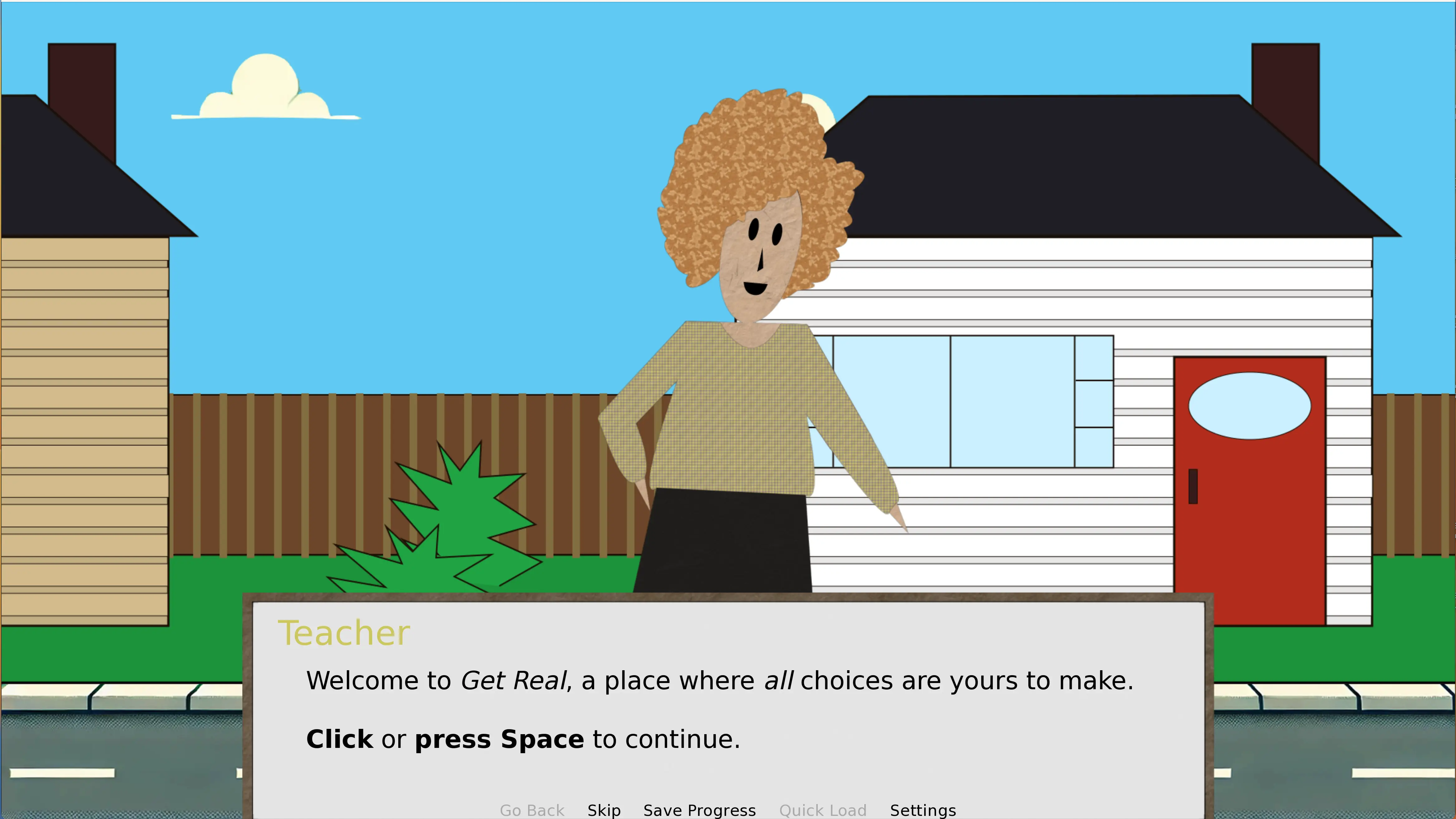
A proven in-person financial-literacy activity needed to reach foster youth beyond the classroom.
The Economic Awareness Council asked the team to transform its paper-based financial-literacy game for foster youth into a scalable digital experience. The design challenge was not to turn the material into a quiz. It was to preserve the consequences, social pressures, and decision-making dynamics that made the original intervention meaningful while removing the need for a facilitator and physical materials.
External partnership, student-team leadership, and a year-long development process.
I originated and managed the client relationship and supervised a five-student EMDD team through evaluation of the original game, narrative and interaction design, collaborative development, usability testing, and final handoff.
My role
Faculty Lead & Project Director. I established and managed the partnership with the Economic Awareness Council and directed the research, design, development, evaluation, and handoff process. Game design and development were completed by Emma Davis, June Fields, Devon Humphery, Bailee Krakowski, and Edwine Pierre Louis.
Financial choices persist across a branching story instead of disappearing after a single question.
Players inhabit the role of a high-school senior navigating work, school, banking, transportation, shopping, relationships, and unexpected expenses. A persistent money system updates as players earn, spend, and save; relationship variables influence dialogue and outcomes; and decisions accumulate toward multiple paths and three endings.
The team deliberately modeled peer pressure and friend-group dynamics. Characters sometimes reinforce good financial decisions and sometimes pull the player toward impulsive spending, allowing the player to experience social influence rather than only read about it.
Twelve foster youth participated across three rounds of remote testing.
The team conducted three rounds of remote usability and playtesting with 12 high-school-aged foster youth. Sessions were conducted over Zoom and followed by interviews so that the team could observe interaction problems while also understanding how participants interpreted the scenarios, tone, and financial choices.
The finished game was handed to the client and is now in use.
The final browser-based experience was formally handed over to the Economic Awareness Council and deployed for use. The digital format removes the facilitator, physical-material, and location constraints of the original game while keeping the client able to update modular scenes and content over time.
The project demonstrates the kind of faculty leadership I value most: a real community partner, a consequential user population, a year-long student team, iterative human-centered evaluation, and a functioning product that continued beyond the course.
A student-authored product within a faculty-led external partnership.
Partner: Economic Awareness Council, Chicago.
Student design & development: Emma Davis, June Fields, Devon Humphery, Bailee Krakowski, and Edwine Pierre Louis.
Faculty lead: Joshua A. Fisher.